Balance rules: the five ways a market leaves a range
Markets spend most of their life in balance: coiling inside a range, doing business, agreeing about price. Traders spend most of their life trying to predict which way the range breaks.
“Plan for what is difficult while it is easy.” – Sun Tzu (The Art of War)
Here is the framework that removes the prediction. When a market is balanced, there are exactly five things it can do, and every one of them has a plan attached. You write the five plans while the market is still coiling. Then, whichever one shows up, you are executing instead of reacting.
No forecasting required. That is the entire trick.
What counts as balance
Balance is the market consolidating in a recognizable range: overlapping value areas, a fattening composite profile, price rotating instead of trending. It happens on every timeframe, from minutes to months, and the rules below apply at every scale.
Potency scales with maturity. The tighter the range and the longer the market holds it, the more energy the eventual resolution carries. Two or more days of balance makes the framework very potent; a market that has coiled for weeks makes it important to stay patient. Don’t let spending a long time inside a balance area get you to force trades.
Marking the area is not complicated: the balance high (BAH), the balance low (BAL), and the composite profile between them (its POC and any singles or poor structure inside). Those two edges are where all five scenarios live. Look for areas where both time (TPOs) and volume taper off, that is often where you should draw your balance area high/low.
There is no set amount of time that makes up a range or triggers the drawing of it. But you need at least one test of one edge and follow-through to know that it is confirmed. So if the market makes a high, pushes lower, then turns around, comes back to that high, looks above it, then fails, you now have a good idea it’s a balance area high. If then price works its way all the way back down to where it turned around before, that is your confirmation that the market is in balance. If it then reverses near the same lows again, you know A) that it’s likely to head back to your high, and B) what the BAL is.
The five scenarios
For each, the setup is the same: balance area defined, edges marked, alerts set. The market approaches an edge, and one of five things happens.
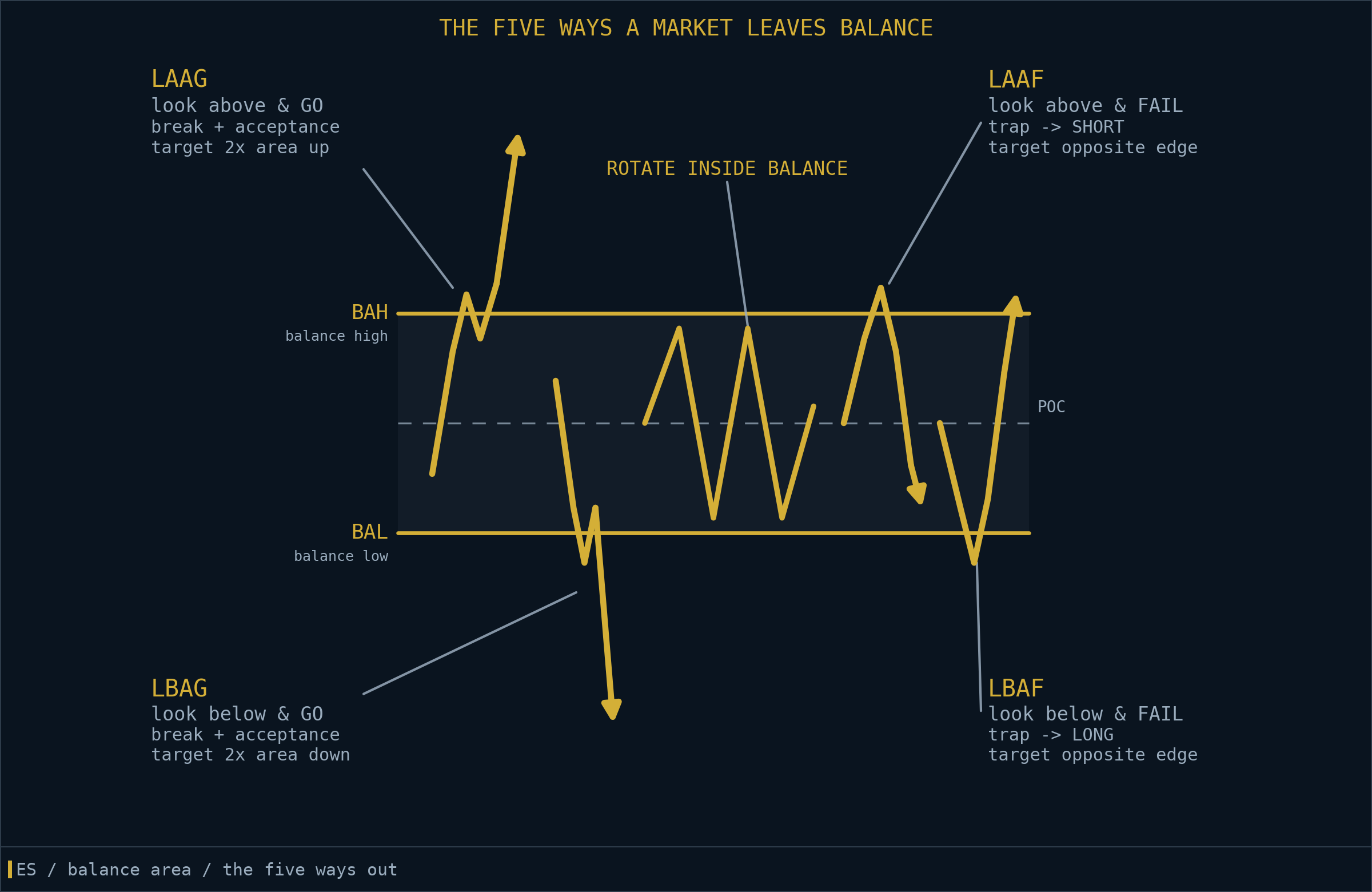
1. Look above and go. (LAAG) Price breaks the balance high, and instead of collapsing back, it finds acceptance: buyers keep working, value starts building above the old range. The market has left balance to seek new business higher. The projection for the move is the width of the balance area itself, so the target is double the balance area measured from its low: the range’s energy, spent directionally.
2. Look above and fail.(LAAF) Price pokes above the balance high, finds nothing (no acceptance, no follow-through), and gets pulled back inside. This is the trap resolving, and it is a short: entry on the failure back inside, stop above the new high the market just printed, target the opposite end of balance. The logic is clean: everyone who bought the breakout is now wrong, and their exits fuel the trip across the range.
3. Look below and go. (LBAG) The mirror of scenario one. Break of the balance low with acceptance: sellers found new business. Target projects the balance width downward, double the area measured from its high.
4. Look below and fail. (LBAF) The mirror of scenario two, and my favorite of the five to trade. The break below finds no sellers, price reclaims the range, and the trade is long with a stop below the fresh low, targeting the balance high on the other side.
5. Remain in balance. The scenario everyone forgets exists, and statistically the most common on any given approach: price tests an edge and simply rotates back. No breakout, no failure drama, just the range continuing. The plan here is rotational trade: responsive entries against the extremes, profile references inside the range as targets, size and expectations dialed down.
What separates “go” from “fail”
The five scenarios are only useful if you can tell one and two apart in real time, so here is the read.
Acceptance looks like time and business: price holding beyond the edge for multiple periods, letters stacking, value visibly migrating out of the old range. The breakout stops looking like an event and starts looking like a new neighborhood.
Failure looks like speed and loneliness: a quick probe, singles behind it, volume drying up at the new prices, then the sharp pullback inside. The tell is often how little happens out there: the market went looking for new business and found an empty room.
You will not catch the exact tick either way. The point of the framework is that you do not need to: both outcomes have a plan, so the only real error is having no position on your list, or worse, arguing with the one that showed up.
Warning: There will be chop
One very important thing to remember when trading these breakouts or failures is that there will be a lot of chop at the balance area high or low. If it’s a multi-day balance, it is very common to spend most of a day or even multiple days just grinding up and down through the high or low. These are extremely frustrating moments. You know there is an excellent opportunity for a trade, you know exactly how to take that trade, but you will get twenty fakeouts first, whipsawing you in and out of positions over and over.
It’s not easy, but if it were everybody would be doing it and it wouldn’t work. Be patient at the BAH/BAL, don’t force trades. Waiting for confirmation of the break or failure means your entry won’t be quite as good, but think of that as the cost of the insurance policy that protects you from the whipsaw. If you take a few trades and get stopped out, stop trying and let that one go.
The mindset clause
This part is in my glossary and belongs in anything written about balance rules: these scenarios are a framework of probabilities, not obligations. The market does not have to do any of it. It is random enough, often enough, that a trader should stay open to every possibility, including the ugly hybrid ones (a failed break that then breaks for real an hour later, it happens all the time; that’s the framework restarting, not the framework not working).
The rules do not make you right. They make you prepared, which compounds better.
I am a master of drawing these balance areas now. I can often predict them before the first reversal, that does not make trading them any easier. They are a huge part of my trading success and also the most painful trades to execute. If you can handle both of these truths at the same time then LAAF, LBAF, LAAG, LBAG, are excellent setups to add to your arsenal.
The mistakes
Don’t bet the break direction in advance. The coil does not lean; you are pattern-matching noise. The framework’s whole value is not needing the call.
Trading the first tick beyond the edge as a “go” is a mistake. Acceptance takes time and volume to prove. The traders who buy the instant break are the fuel for the failure.
Don’t move your stop on a fail trade too soon. The failure scenarios come with the cleanest invalidation in trading: the fresh extreme just printed. Beyond it, the fail thesis is simply wrong. Know that it will chop a lot, give it time and space to follow through.
Don’t forget scenario five. Most edge approaches resolve back into rotation. If your plan only covers breakouts and traps, you are unprepared for the most common outcome.
Don’t ignore what sits outside the range. A naked POC or a stack of weak references just beyond an edge is a magnet that helps a “go” travel, and worth checking before you set targets.
FAQ
What is a balance area in trading?
A range where the market is consolidating and doing two-way business: overlapping value, rotation, a fattening profile. The auction agreeing with itself, on any timeframe.
What does “look above and fail” mean?
Price probes above a balance area, finds no acceptance, and falls back inside. It flips directional: the failed breakout becomes a short targeting the other side of the range, with a stop above the new high.
How do you set targets from a balance breakout?
The classic projection is the balance area’s own width: a genuine break targets double the balance area, measured from the opposite edge. Pair it with references in the path (old POCs, prior extremes) rather than using the projection blindly.
Do balance rules work intraday and on higher timeframes?
Yes, both. The auction logic is scale-free. Potency scales with the balance’s maturity: a multi-week coil resolves with more energy than a lunchtime one.
Is balance the same as consolidation?
Same behavior, different vocabulary. “Balance” is the auction-theory framing, and it comes with the useful add-ons: value areas, composite POCs, and the five-scenario playbook.
Charles Gough is a full-time ES futures trader and the founder of Pirate Traders.