Market profile day types: a session’s six personalities
Days have personalities. Some spend six hours arguing about a thirty-point range. Some pick a direction at 9:31 and never look back. Some do both, which is how most traders get hurt.
The day-type framework, straight out of the market profile literature, gives those personalities names. The names matter less than what they train you to see: how much conviction is in the session, which side owns it, and whether today is a day for fading edges or leaving them alone.
One thing before the list. You never know the day type in the morning. You develop a hypothesis, and the day confirms or breaks it. The classification is a lens for reading the session in progress, not a prediction to make at 9:45.
The variable underneath the names
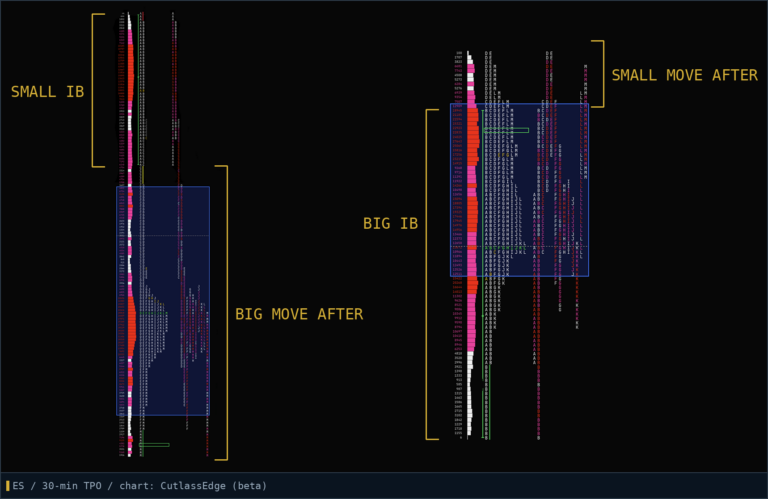
Every day type is really describing one thing: how the session treats its initial balance, the first hour’s range.
Little to no extension beyond the IB means the opening auction found fair prices and the day is rotational. Persistent one-sided extension means bigger-timeframe money is participating and repricing the session. Extension on both sides means conviction is genuinely mixed and the day is a coin argument.
Hold that in your head and the six types below stop being a taxonomy to memorize and start being one dial read six ways.
The six types
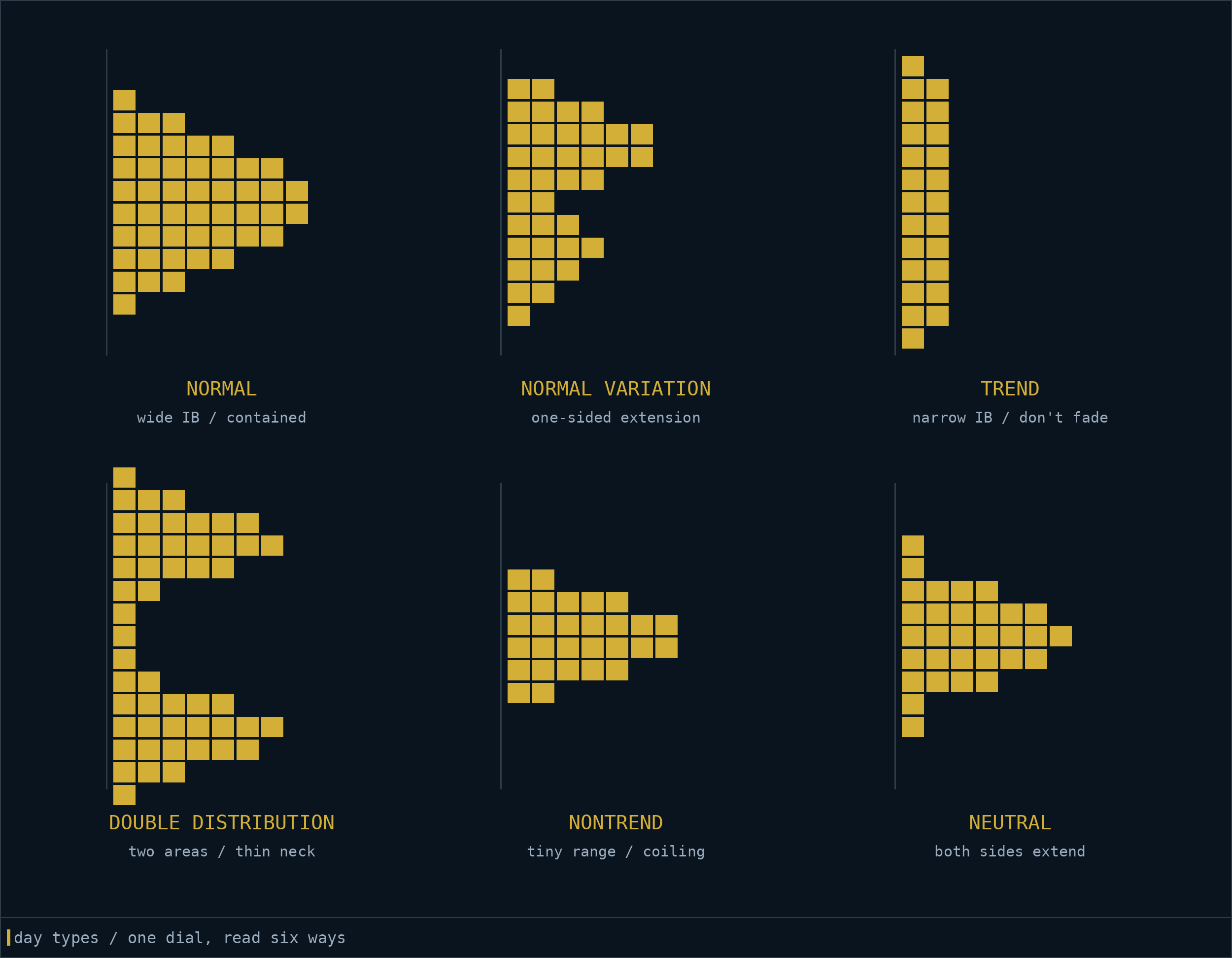
Normal day. A wide initial balance that contains the whole session. The big early range came from a burst of activity at the open, then the day balances inside it and rotates. Fade-the-edges conditions. The joke writes itself: genuinely “normal days” are not very common, they only happen about 2% of the time on the ES.
Normal variation day. The workhorse. A moderate IB, then one side extends the range in the morning or early afternoon, often stretching the day to roughly double the opening bracket, before value gets built at the new prices. One-sided conviction, but orderly.
Trend day. The important one. A narrow initial balance, then relentless directional extension: new letters printing one-sided period after period, value dragging behind price all day, closes near the extreme. On a TPO chart it is the tall thin elongated profile. The rule that pays for this entire article: do not fade a trend day. The market is one-timeframing, and every “it’s too extended” entry is a donation.
One of the Jim Dalton quotes I hear in my head every time we have a trend day is “it will shock you how far they can push it when they have the momentum”. It’s true, regardless of how many times I’ve seen it happen, a true strong trend day always has me convinced it “can’t keep going”, but then it does. The trend is your friend, go with your friend, don’t fight them.
Double-distribution trend day. The market does business in one area, discovers new information or new conviction, repricing violently through a stretch of single prints, then builds a second area of business. Two fat distributions, one thin neck. The neck is the reference: acceptance back into it questions the whole move. Sometimes the market will leave behind two or three sets of single prints, and we still think of this as a double distribution.
Nontrend day. Tiny range, no conviction, no extension. Usually the market waiting on something (a Fed afternoon, a jobs morning). The mistake is manufacturing trades out of boredom; the opportunity is the coiling itself, since nontrend days feed the balance rules playbook.
Neutral day. Range extension beyond both sides of the IB: both the buyers and sellers from bigger timeframes showed up and disagreed. Where the day closes decides the message. A neutral-center close (near the middle) is a market in genuine balance. A neutral-extreme close (at one end) says one side won the argument late, and carries directional information into tomorrow.
Using this in real time
Here is the honest sequence, because the textbook version implies more certainty than the screen ever gives you.
At the IB completion you have a width read: narrow IB keeps trend day and double distribution on the table; wide IB leans normal or normal variation. That is a bias, not a call.
Through the late morning, extension quality updates it. One-sided extension with letters stacking and value migrating: normal variation graduating toward trend. Extension that keeps getting tailed back: rotation lives, and edges are tradeable.
By early afternoon the day usually confesses. And the confession is only worth something if it changes your behavior: rotational days reward fading structure at the edges of value, trending days punish it, and the entire skill is not applying yesterday’s personality to today’s tape.
The mistakes
Do not decide the type at 10:00 and defend the opinion all day, that is fuel for confirmation bias. The day type is a running hypothesis. Strong opinions, loosely held, updated hourly.
You can’t force every session into a box. Plenty of days are hybrids or nothing much. “Unclear” is a legitimate classification and often the most honest one.
Fading trend days because the profile “looks stretched” is always the wrong move. Elongation is not exhaustion. The profile literature is unambiguous here and so is my P&L history.
Don’t start collecting day-type statistics as if they were signals. Knowing trend days happen roughly once or twice a week on average does not tell you which day. The framework reads the present; it does not schedule the future.
FAQ
How many market profile day types are there?
The classic taxonomy has six: normal, normal variation, trend, double-distribution trend, nontrend, and neutral (with neutral-center and neutral-extreme closes distinguished). Traders collapse or extend the list; the underlying read is IB width plus range-extension behavior.
What is the most common day type?
Normal variation days and rotational in-between days make up most of the calendar. True trend days are a minority of sessions, which is exactly why they hurt so many people.
How early can you identify the day type?
You can form a bias when the initial balance completes and a working conclusion by early afternoon. Anyone claiming certainty at the open is selling confidence, not analysis.
Do day types still work in algorithmic markets?
The names are old; the behavior is current. Sessions still open, auction, and either balance or reprice, whoever (or whatever) is doing the clicking. What has changed is tempo and range size, so calibrate to your market’s present rhythm.
What is a neutral day in market profile?
A day with range extension beyond both ends of the initial balance: both sides of the bigger-timeframe money participated. The close location (center versus extreme) carries the message.
Charles Gough is a full-time ES futures trader and the founder of Pirate Traders.
Market Profile is a registered trademark of CME Group. It’s used here descriptively, to discuss the methodology.