Why most day traders fail: what the research actually says
Every corner of this industry has a financial interest in not answering this question straight. Course sellers need optimism. Brokers need volume. Influencers need the dream intact. And traders themselves, me included, need to believe the work leads somewhere.
So let’s do the thing nobody’s incentives favor and read the actual research. It is worse than the sales pages admit, better than the cynics claim, and more useful than both, because the studies do not just count the bodies. They describe the survivors.
The Brazilian study: persistence is not enough
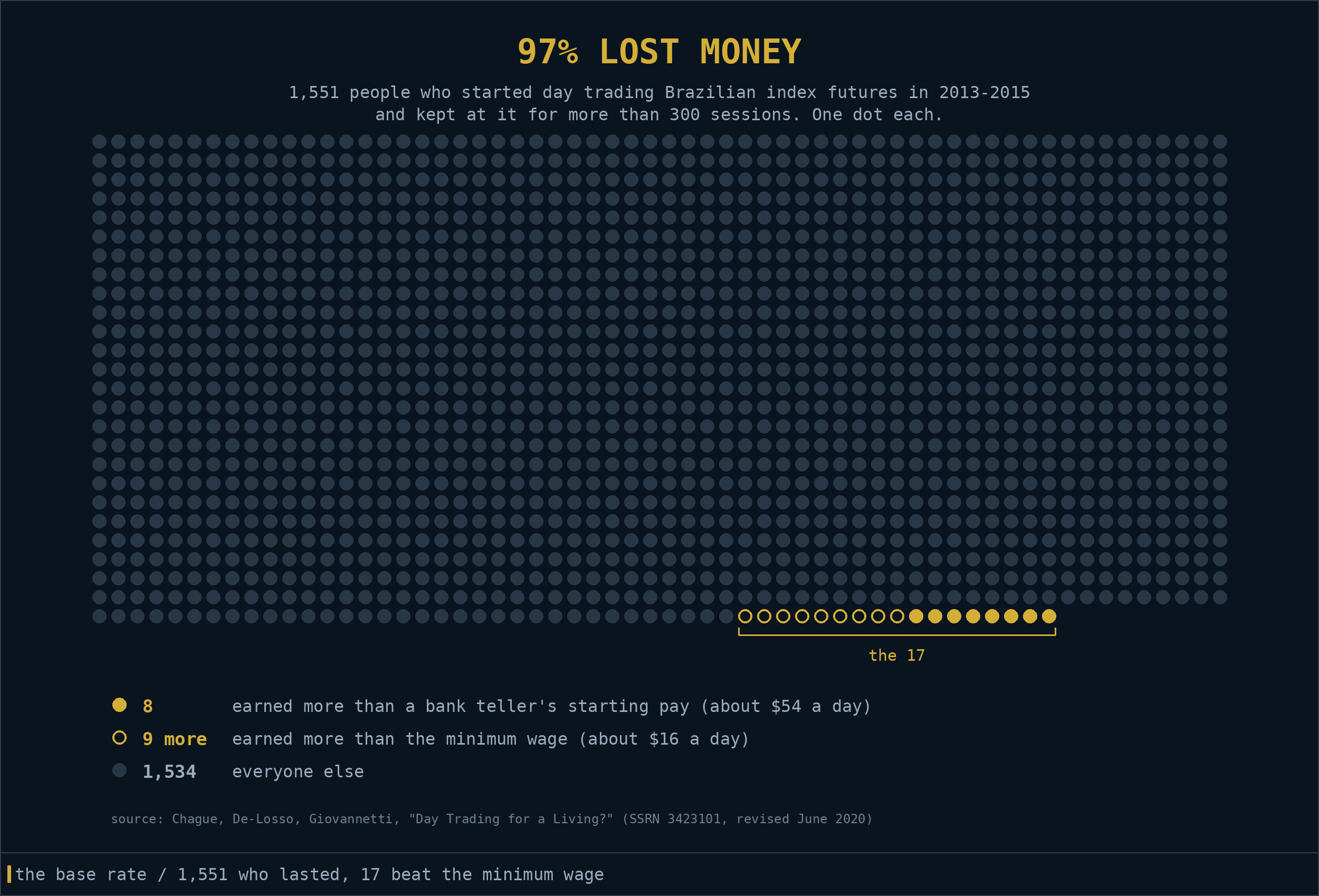
The cleanest dataset in the field comes from Brazil. Fernando Chague, Rodrigo De-Losso, and Bruno Giovannetti, in a paper bluntly titled “Day Trading for a Living?”, tracked every individual who began day trading Brazilian equity index futures between 2013 and 2015. Not a sample. Everyone.
The headline finding: among people who persisted for more than 300 sessions, more than a full year of trading days, 97 percent lost money. Persistence, the quality every trading motivational post celebrates, did not save them. Only 0.5 percent, 8 people out of 1,551, earned more than a Brazilian bank teller’s starting pay (about 54 US dollars a day), and the single best performer among them averaged about 310 US dollars a day, earned with a daily standard deviation around 2,560 dollars. Read that pair of numbers twice: the best seat in the room paid a modest salary with a violence of swings most people could not psychologically survive.
The finding underneath the headline is the one that should change behavior: the authors found no evidence of learning by day trading. Performance did not improve with experience. More screen time, same results. Whatever separates the rare winners, it was not accumulating automatically with hours served.
The Taiwan study: skill exists, and it is brutally scarce
The deepest dataset comes from Taiwan, where Brad Barber, Yi-Tsung Lee, Yu-Jane Liu, and Terrance Odean analyzed essentially all day trading on the Taiwan Stock Exchange across 1992 to 2006, published as “The Cross-Section of Speculator Skill.”
Two findings, and you need both.
First: fewer than 1 percent of the day trading population predictably and reliably earned positive risk-adjusted returns net of fees. Not “1 percent got rich.” Fewer than one in a hundred could beat their own costs dependably.
Second, and this is the half the doom crowd skips: the tiny top group was not lucky. The best performers in one period kept winning in the next, with the top-ranked traders earning meaningful returns after costs. Skill in this game is real, measurable, and persistent. It is simply concentrated in a population so small that betting on being in it, by default, is statistically indistinguishable from a lottery ticket.
The same authors’ companion work asked whether losing traders rationally learn and quit. Mostly, no. The majority keep trading through sustained losses, which tells you the feedback loop in this activity is broken in some deep way. That broken loop is, I think, the actual answer to this post’s title.
Why the numbers are this bad
The studies count outcomes. The mechanisms are visible from any trading desk.
Costs compound at frequency. Every trade pays spread and commission. A day trader crosses that toll bridge dozens of times a week, which means the breakeven point is not zero, it is a persistent headwind that most participants never even calculate. In Europe, regulators forced brokers to print the resulting arithmetic on their own products: every CFD provider’s standardized warning states the share of its retail accounts that lose money, and the national regulators’ own analysis put that share at 74 to 89 percent. That range came from regulators, not pessimists.
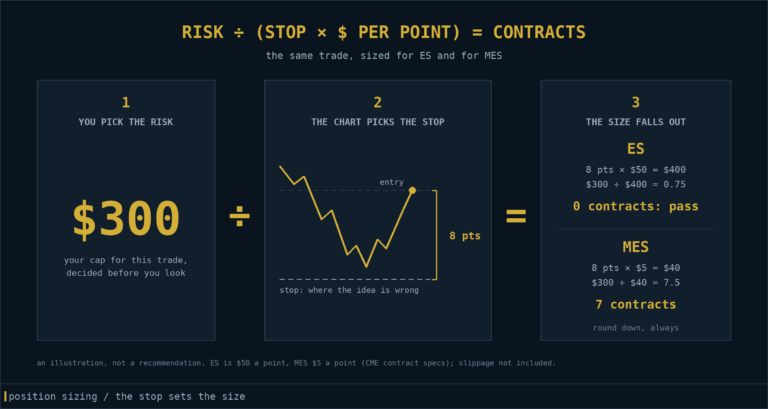
Leverage converts variance into ruin. Futures let a modest account swing size it has no business swinging. Ordinary losing streaks, the kind any honest sample contains, arrive eventually, and at careless size an ordinary streak is a funeral. The sizing arithmetic is not advanced, which makes it stranger that it goes unread; ruin is almost always a position-size decision wearing a market-opinion costume.
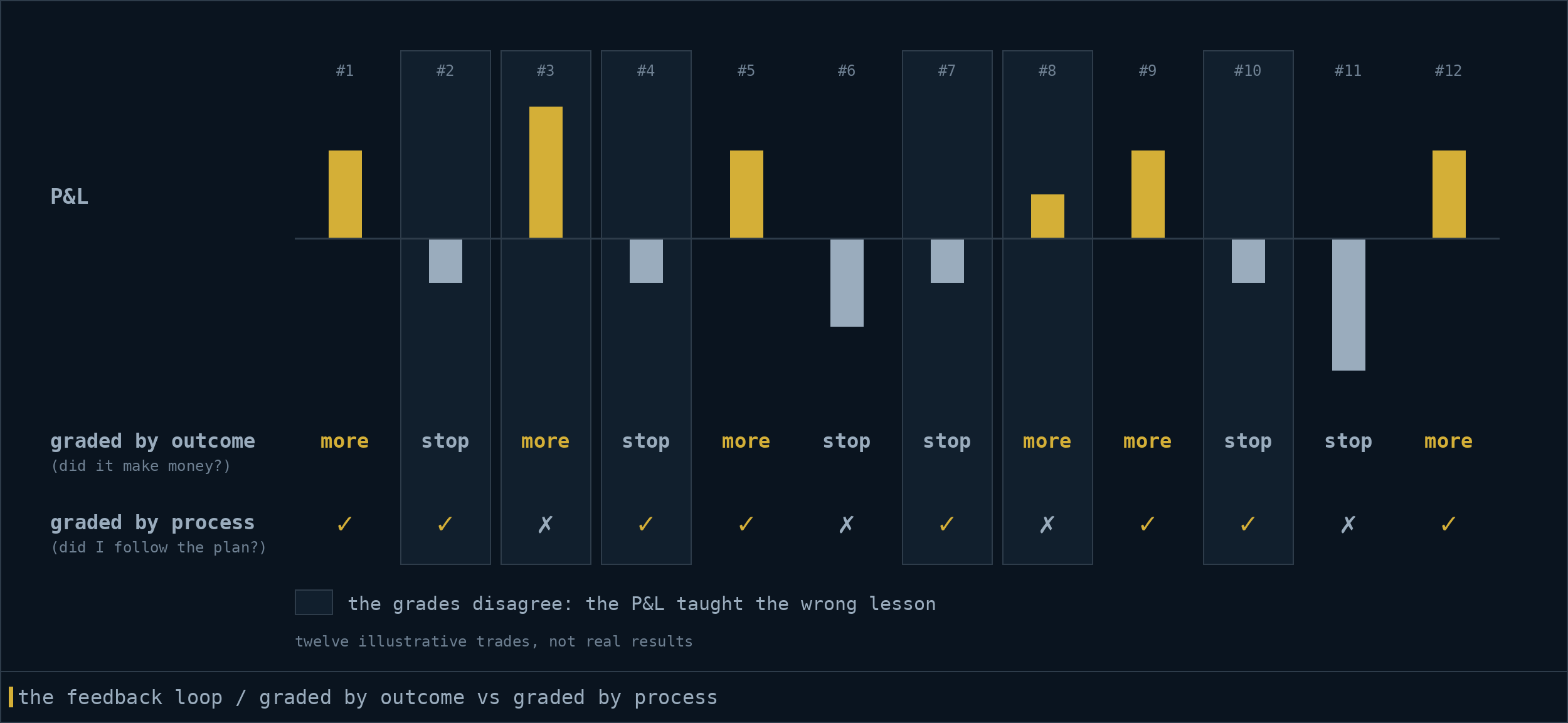
The feedback is a casino’s, not a classroom’s. This is the deep one, and it is why experience alone fixes nothing. Markets pay out on a delay, with noise. Bad decisions get rewarded for weeks; good decisions get punished in streaks. A learner in that environment, grading themselves by P&L, is training on corrupted labels: they learn the lesson variance taught, not the lesson skill required. Without deliberate structure, written setups, counted samples, process grades instead of outcome grades, screen time is just expensive exposure to randomness.
Survivorship curates the evidence. The traders a beginner sees are the visible ones, and visibility selects for the lucky and the loud. Ninety-seven of a hundred quiet losses produce no content. The three survivors produce all of it, and one of the three is lying.
The uncomfortable synthesis
Put the two studies side by side and the honest conclusion is not “day trading is impossible.” It is narrower and harder: day trading is a legitimate skill practiced profitably by a very small population, and the default path, showing up, trading, accumulating experience, does not lead into that population.
Which reframes the entire project. The rational question is not “how do I get profitable?” It is “how do I buy the longest possible period of high-quality learning for the least tuition, and how will I know, from evidence, whether I am converging or just persisting?” Every craft habit worth building is a working answer to that question: micro-sized tuition, defined setups, counted samples with honest n, plans graded on process, invalidations that produce information instead of just pain. Not because process guarantees a seat in the 1 percent. Nothing does, and anyone selling a guarantee is charging you for arithmetic the regulators already printed. Process is simply the only known way to make the feedback loop honest enough that, if you are not converging, you find out cheaply and can stop.
My own tuition
I had a great job making television promos and movie trailers. I was trying to learn about investing, but at the time I was just buying index funds with a 30-year time horizon, and making money that way felt pretty boring.
Then one day a colleague told me a very good story: the story of Satoshi Nakamoto and Bitcoin. I was fascinated by the idea that this new form of money could change the entire global monetary system, and that if I got in early I could prosper from it. This was around 2017. I began to dip my peg leg into the world of trading crypto, and I absolutely loved it. In hindsight, I was just gambling. I had no idea how to trade or manage risk; I was literally buying cryptos because I liked the look of the pictures of the people on their About Us page. I didn’t understand any of the technology or have any kind of edge. But I was lucky and happened to enter the fray right at the start of a massive bull market bubble. As they say, everyone is a genius in a bull market. I was hooked! I made a lot of money. My returns were more than 20x my investment, and I was genuinely planning to quit my job and go full time as a crypto trader. But like all bubbles, it eventually popped.
And because I didn’t know what I was doing, I just kept buying every dip. Then it would dip further, and I would buy more. By the final drop in December 2018, I accepted my losses and sold everything. I capitulated at the lows. I “got wrecked,” as the crypto YouTubers would call it. In the end I gave back all my gains and took losses on top. Six months later, Bitcoin had more than quadrupled from where I sold, and within two years it was at new all-time highs. I learned a truly painful but powerful lesson. I needed to learn how this actually worked. I needed to stop chasing the fun and the thrill and figure out how the pros manage to make money at this consistently, for decades. I was trading ES full time less than two years later. When I changed my approach from chasing the fun to trying to master a skill, the question changed too: not how do I get rich, but how do I learn this without blowing up again.
Choosing with your eyes open
If you have read this far and still want the game, good. It is a real craft, the auction is a beautiful puzzle, and somebody occupies that thin right tail. But go in with the numbers on the table: the base rate says most people in your seat lose, persistence alone does not bend that curve, and the exceptions the data can actually see look like disciplined process operated at survivable size for a long time.
The market owes nobody a living. It does, reliably, pay out one thing to everyone who shows up with structure: an education in probability, self-knowledge, and the price of certainty. Whether that education ever converts into a paycheck is a question your own counted results will answer better than any post, any course, and certainly any highlight reel.
FAQ
What percentage of day traders are profitable?
The strongest studies put reliable after-cost profitability at fewer than 1 percent of participants (Taiwan, 1992-2006), with 97 percent of persistent day traders losing money outright (Brazil, 2013-2015 cohort). Exact figures vary by market and definition; no serious dataset puts the number anywhere near the majority.
How long does it take to become a profitable day trader?
The honest answer from the data: time alone does not do it. The Brazilian study found no performance improvement with experience, and the Taiwan work shows most losing traders simply continue losing. Progress, where it happens, tracks deliberate process and honest measurement, not calendar time, and nobody can promise it happens at all.
Is day trading just gambling?
Structurally, no: a tested process with positive expectancy is possible, and a small population demonstrably sustains it. Functionally, for a participant with no defined setups, no counted sample, and outcome-based feedback, it reproduces gambling’s mechanics with worse ambiance.
Should I day trade for a living?
That is a personal decision this site does not make for people, and the research is titled “Day Trading for a Living?” with the question mark earned: the base rates say do not plan a life around being the exception. If you pursue it, do it at tuition-controlled size, with evidence standards, alongside income that does not depend on the market’s mood.
Charles Gough is a full-time ES futures trader and the founder of Pirate Traders.