Auction market theory in plain English
Ask ten traders why price moved and you’ll get news, conspiracies, an algorithm with a grudge, and someone blaming the Fed regardless of the day.
Auction market theory is the boring, correct answer underneath all of it: the market is a two-way auction whose job is to facilitate trade, and everything on your chart is that auction either doing its job or searching for a place where it can.
This is the theory that market profile was built to display. You can read the profile guide first and come here for the why, or start here. Either order works; the two are one idea.
The market has a job
A market exists to do one thing: facilitate trade. Not to be fair, not to make sense, not to reward your analysis. It exists to find the prices where buyers and sellers will transact, and to advertise for more business when transactions dry up.
That single sentence demystifies most price behavior. Why did it rally on bad news? Because sellers finished and the auction needed to advertise higher to find new business. Why did it stop dead at a random number? Because two-sided trade appeared there and the advertising could stop. The market is not talking to you. It is running an auction, continuously, in both directions.
The three-part engine
The classic formulation, and it has never needed improving: price advertises opportunity, time regulates it, and volume measures whether the advertising worked.
Price moves first and means least. A tick higher is an advertisement: anyone want to sell up here? Time is the regulator: if the market spends real time at a price, that price is being accepted as a fair place to do business. Volume is the verdict: business either shows up at the advertised price or it does not.
This is why chasing price alone is structurally losing: you are trading the advertisement instead of the response. The whole discipline of auction-based trading is watching how time and volume answer each new price.
A two-sided auction
Imagine an art auction: the auctioneer brings out the painting. While he talks about it, everyone in the room decides whether they want to buy the painting and how much they’re willing to pay for it. They all have different reasons; some might want it because they think it’s pretty and they want to put it on their wall. Some might want it as an investment to lock up in storage. Some might just want to bid on it to push the price up, so that others in the room spend their money early and have less dry powder for later in the auction. Everyone has their own idea of what the painting is worth and how much they’re willing to pay for it.
As the auctioneer begins the bidding, lots of hands will go up in the air: that’s volume. When the auctioneer sees that, he will raise the bid very quickly: that’s price moving at a fast tempo. As he continues to lift the bid, fewer and fewer hands will go up in the air as people in the room begin to feel the painting is getting too expensive: that’s volume tapering off. When the auctioneer sees the volume taper off, he will slow the speed that he moves from one price to the next: that’s time regulating. The slower he goes, the more time the participants in the room have to decide if they’re willing to pay this higher price.
Eventually, there will be only two participants left bidding. At this point volume is very thin, so the auctioneer slows way down, making sure both participants are absolutely certain they are not willing to pay a higher price. Once the last bid is in, the auctioneer slams his mallet down and says SOLD!
Because there’s only one painting, at this point, the auction is over. But in the case of the stock market or the futures markets, there is an unlimited number of paintings, so the auction goes both ways, up and down. When no one is willing to bid any higher, price reverses and heads the other way.
When we trade we are watching the whole room, where the price is going, how much volume is trading at those new price levels, and how much time the market has to stay at those levels to bring in that volume. The skill is in recognizing when an auction is coming to an end, or a new one is beginning.
Balance and imbalance: the only two states
Zoom out far enough and the market is always doing one of two things.
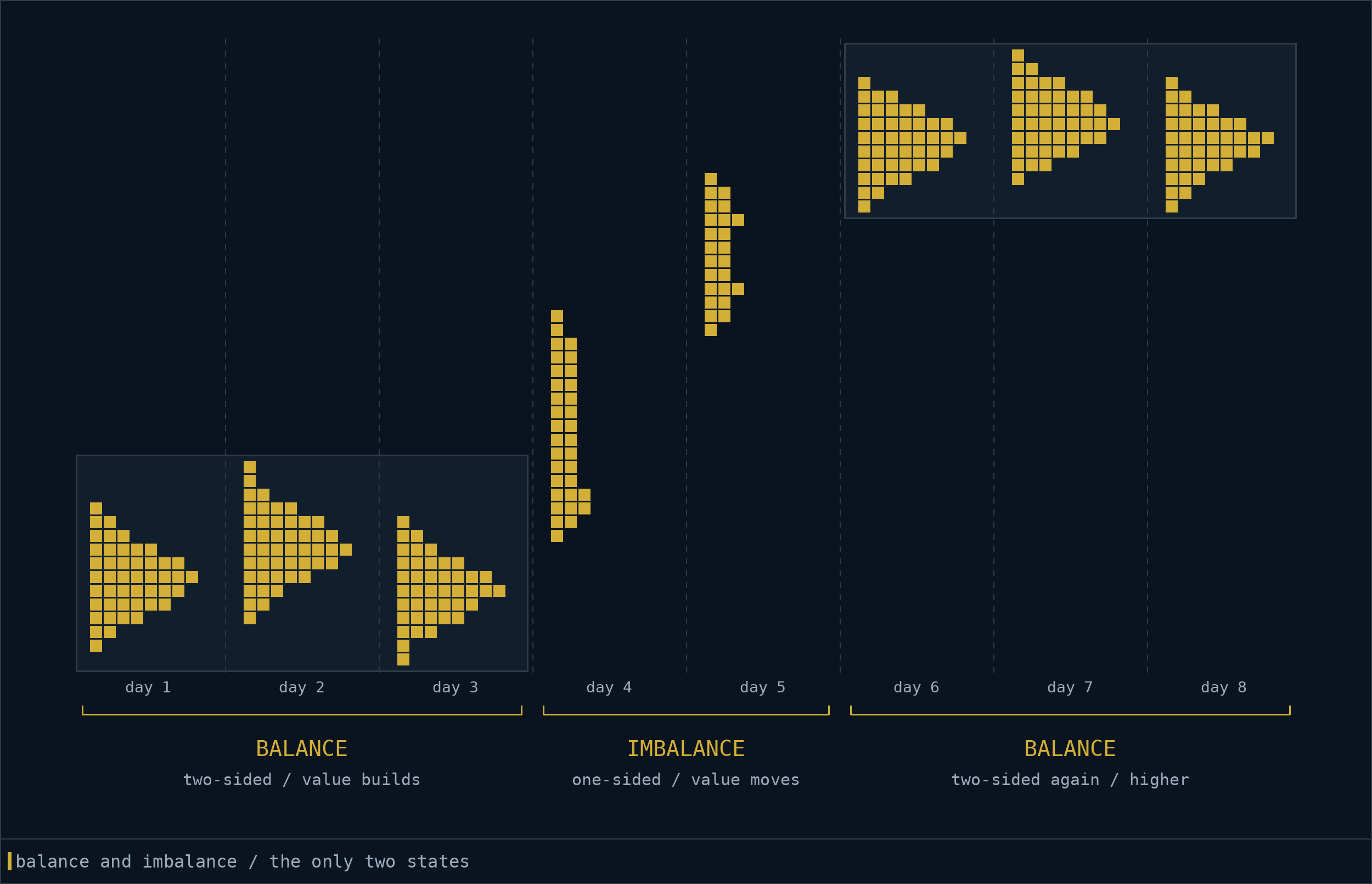
Balance: the auction has found an area where both sides willingly transact, and it rotates there, building value. Efficient, two-sided, boring, and the majority of all market life. On the profile it prints as the fattening bell and overlapping value areas.
Imbalance: something has convinced one side to stop transacting at the old prices, and the auction moves, advertising directionally until it finds the other side again. On the profile: elongation, one-sided day types, value migrating instead of building.
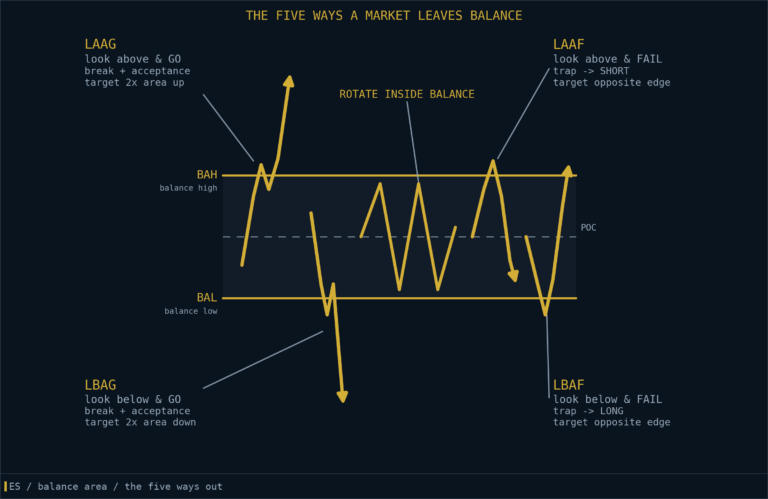
The rhythm of markets is just this cycle: balance, break, imbalance, new balance. Which is why the balance rules framework is so central: the transitions between the two states are where the clearest trades live, and the theory tells you what a genuine transition needs to look like (time and volume accepting the new prices, not price alone poking at them).
Initiative and responsive: who is doing what
One more pair of words that pull their weight. Every act in the auction is one of two kinds.
Responsive behavior (buying dips/selling rips) is the market’s immune system: buyers responding to cheap prices below value, sellers responding to expensive ones above. Responsive traders defend the current balance.
Initiative behavior (buying rips/selling dips) is conviction: buying above value, selling below it, choosing to do business at prices the market already called unfair. Initiative activity that keeps finding volume is how imbalance starts and sustains.
Reading any session largely reduces to asking: who just acted, and were they responding to price or initiating against it? A probe above value that meets responsive selling and dies is the balance holding. The same probe met by more initiative buying is a market leaving town, and the theory’s advice is unsentimental: do not stand on the tracks. When every period prints a higher high and a higher low, the market is one-timeframing, initiative money is in full control, and the only theory-approved options are join it or watch it.
What the theory earns you, and what it doesn’t
Here is the honest close, because auction market theory gets sold as a secret and it is not one.
AMT will not predict anything. It has no targets, no setups, no win rate. What it does is replace the question “what will the market do?” (unanswerable) with “what is the market doing right now?” (answerable, every single session). Is it balancing or seeking? Accepting or rejecting? Who is doing business? Where did the last auction finish improperly (the unfinished business)?
Traders who can answer those questions in real time stop taking a whole category of bad trades: the fade of the trend day, the breakout chase into responsive sellers, the revenge short at accepted prices. The theory’s edge is subtractive. It removes the trades where you were fighting the auction itself, and what remains gets to compete on your actual skill.
The auction does not care that you finally understand it. But you will lose money more slowly and for better reasons, and in this business that is the beginning of every good thing.
FAQ
Who created auction market theory?
The framework grew out of J. Peter Steidlmayer’s work at the Chicago Board of Trade in the 1980s, where market profile was developed as its visual display, and was expanded and popularized in the books of Jim Dalton and his co-authors (Mind Over Markets, Markets in Profile).
Is auction market theory the same as market profile?
They are a pair: AMT is the theory of how markets move; the profile is the chart built to display it. You can hold the theory with any chart, but the TPO chart was purpose-built for it.
Does auction market theory work on stocks and crypto?
The logic applies to any liquid two-sided market, because it describes price discovery itself. The best-documented application is futures, and thin markets auction badly, which the theory itself predicts.
Is AMT still valid in algorithmic markets?
Yes, and the reason is structural: algorithms changed who transacts and how fast, not why prices move. Auctions still advertise, regulate, and confirm. Tempo changed; the auction mechanism did not. Algos make things feel more random, because they change the auction instantly and often, but the moves read the same.
What is the best book on auction market theory?
Mind Over Markets (Dalton, Jones and Dalton) is the standard entry. Read it before Markets in Profile, read it slowly, and read it twice.
Charles Gough is a full-time ES futures trader and the founder of Pirate Traders.
Market Profile is a registered trademark of CME Group. It’s used here descriptively, to discuss the methodology.